Skin Care Education
HydraFacial for acne-prone and oily skin
If you have oily or acne-prone skin, finding treatments that genuinely help can feel like trial and error. Some facials leave skin irritated, while others focus on relaxation rather than addressing the congestion that’s driving your breakouts in the first place.
HydraFacial has become a popular option for oily and congested skin because it combines exfoliation, extraction, and hydration in a single treatment. While it isn’t a cure for acne, it can play a valuable role in managing congestion and supporting overall skin health.
Table of Contents
Here’s what HydraFacial can and can’t do for acne-prone skin, and how it fits into a broader treatment plan:
Why HydraFacial works for congested skin
Congested skin has a specific problem: it produces more sebum, which mixes with dead skin cells and settles in pores. Left unchecked, that congestion becomes the foundation for blackheads, whiteheads, and inflammatory breakouts. Most facials address the surface, but HydraFacial is designed to help clear congestion within the pores.
The extraction step explained
HydraFacial’s second step uses patented Vortex-Fusion technology: a spiral-tipped suction system that creates a vortex effect inside the pore, simultaneously drawing out congestion and infusing hydrating serum. There is no manual squeezing, no pressure, and no skin trauma. For oily and congested skin types, this is significant.
Manual extractions, the kind you might experience at a traditional facial, push against the skin to dislodge congestion. That pressure can spread bacteria, aggravate inflammation, and leave redness that lingers for hours. The vortex extraction method does the same clearing work without the manual pressure, which means less post-treatment irritation and a lower risk of making existing breakouts worse.
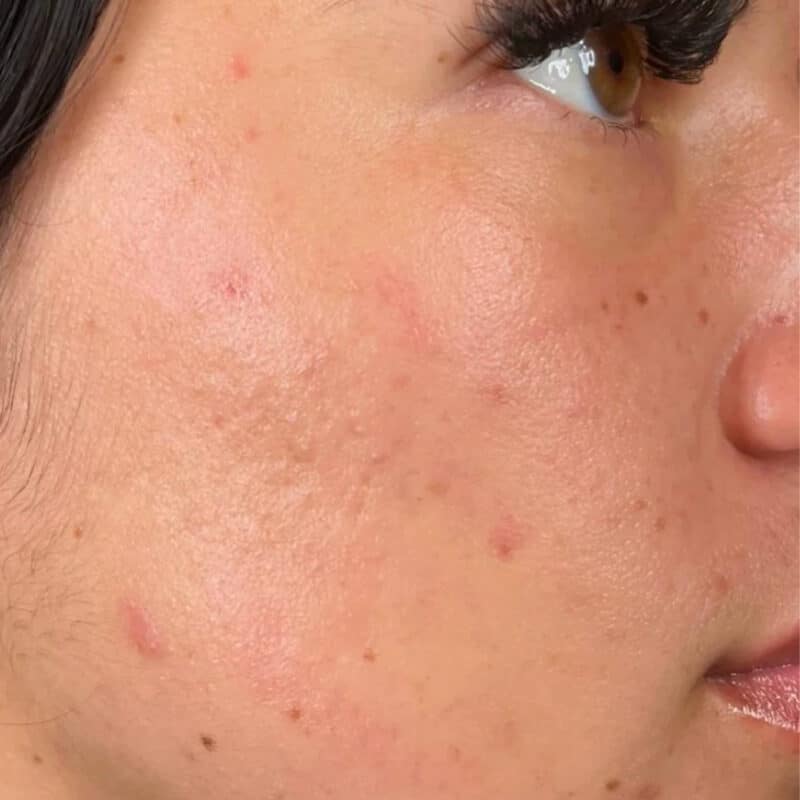 After
After
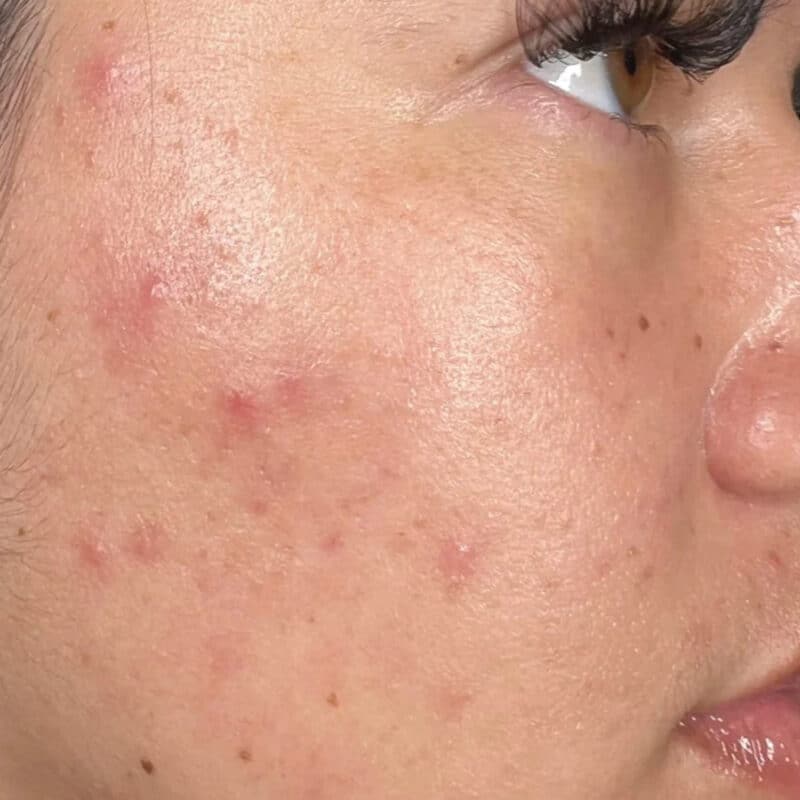 Before
How the salicylic blend supports breakout-prone skin
The GlySal serum used in HydraFacial’s first step combines glycolic and salicylic acids. Salicylic acid is oil-soluble, which means it can dissolve into sebum and penetrate the lining of the pore rather than just working on the surface. It loosens the bond between dead skin cells and the pore wall, making congestion easier to extract and less likely to reform quickly.
For oily and breakout-prone skin, this helps loosen congestion before the extraction phase begins. The combination of chemical loosening followed by mechanical removal is more effective on congested skin than either approach alone.
How to know if HydraFacial is right for you
CoYou might be a great candidate for HydraFacial if your skin is:
- Oily, especially through the T-zone, with enlarged or frequently congested pores
- Prone to blackheads, whiteheads, or non-inflammatory comedones
- Breaking out in cycles with calmer periods in between
- Dealing with post-breakout dullness or mild texture irregularity
- Looking for a no-downtime treatment you can fit around your real schedule
HydraFacials are also a good monthly maintenance tool if you are already managing your acne with topicals or prescription skincare and want in-clinic support that keeps congestion from building between your other treatments. Your esthetician can adjust the serums and boosters to suit your skin on the day, so the treatment responds to where your skin currently is rather than following the exact same protocol every time.
When to wait or skip a session
HydraFacial is gentle for most skin types, but congested and acne-prone skin has a few specific scenarios where timing matters.
Active cystic flare-ups
Cystic acne develops deep below the skin surface, where the vortex extraction cannot safely reach. The lesions are closed, inflamed, and painful, and any suction or pressure over active cysts risks further inflammation or rupture beneath the skin. If you are in a flare with several active, deep, inflammatory breakouts, it is worth rescheduling until that phase has calmed.
Isolated surface congestion and a couple of small active spots are different. A single breakout or cluster of blackheads does not mean you need to wait. Your esthetician will assess your skin at the start of the session and work around any areas that need it.
Sunburn or recent irritation
Come in with clean, calm skin. Active sunburn, open lesions, compromised skin barrier, or a recent chemical peel or resurfacing treatment that has left your skin reactive are all reasons to hold off. The acids in the HydraFacial serums, mild as they are, will irritate compromised skin more than usual. When the barrier is intact, the treatment is comfortable. When it is not, even gentle acids can sting.
If you are currently using a prescription retinoid, let your esthetician know. Some protocols call for pausing your retinoid for a few days before treatment and resuming 24 hours after, just to give the extraction step a clean, non-sensitized canvas to work with.
Timing HydraFacials around your skin cycle
Oily and acne-prone skin often runs in cycles. Hormonal fluctuations, stress, diet and weather all influence how congested or reactive your skin behaves at any given time. Getting the timing right means more from each session and less rescheduling.
The most common treatment interval for acne-prone skin is monthly, as that cadence aligns roughly with the skin’s natural turnover cycle. Monthly visits also let your esthetician track how your skin is behaving over time and adjust the treatment accordingly.
If you know your skin follows a hormonal pattern, try to book in the calmer phase of your cycle rather than the week before your period, when oil production and sensitivity tend to peak. If your skin is more reactive in summer, build HydraFacials into a more frequent summer schedule and space them out a little more in the drier winter months when the oil production calms down.
The other timing question is what to avoid immediately after. Skip the gym for 24 hours, avoid active skincare like retinoids and exfoliating acids for the same window, and do not layer heavy makeup straight after. You have just cleared your pores. Keep them that way while the post-treatment serum does its work.
What HydraFacial cannot do for acne
HydraFacial does not address the root causes of acne. Hormonal fluctuations, excess sebum production, Cutibacterium acnes bacteria, and chronic inflammation are all driving forces behind chronic breakouts, and none of them are in scope for an esthetician facial. If you have moderate to severe acne, persistent cystic breakouts, or a skin concern that has not responded to over-the-counter management, a dermatologist is the right first stop, not a facial.
What HydraFacial does well is reduce congestion, improve surface clarity, support a healthy barrier with hydration, and create better conditions for your other skincare to perform. For many people with mild to moderate oily and breakout-prone skin, that is exactly what they need from an in-clinic treatment. For more complex acne, it is a useful complement to medical management, not a standalone fix.
Pairing HydraFacial with PRX or microneedling for post-acne marks
If your skin concern goes beyond active congestion into the territory of post-acne marks, uneven texture, or shallow scarring, two treatments available at OrangeTwist pair naturally with a HydraFacial routine: PRX-T33 and microneedling with SkinPen.
PRX-T33 is sometimes called the no-peel peel. It uses a blend of trichloroacetic acid, hydrogen peroxide, and kojic acid in a formulation that stimulates collagen and addresses pigmentation deeper in the skin without the flaking, peeling, or downtime of a traditional chemical peel. For post-inflammatory hyperpigmentation, the flat dark marks that linger after a breakout clears, PRX works on the melanin component of those marks while simultaneously supporting collagen quality in the surrounding skin. There is no real recovery window, which means it pairs well with a HydraFacial routine without disrupting your calendar.
SkinPen microneedling takes a different approach. It creates controlled micro-channels in the skin that trigger the body’s natural collagen production response. Over a course of sessions, this improves the texture of post-acne marks, softens shallow scarring, and refines pore appearance. It is a more significant commitment, with around 24 to 48 hours of redness after each session, but the results on texture are more substantial than anything a surface-level facial can deliver.
Depending on your concerns, HydraFacial may be combined with treatments such as PRX-T33 for post-inflammatory pigmentation or microneedling for textural acne scarring. Your provider can help determine the most appropriate approach during your initial You Review consultation
Frequently Asked Questions
It depends on the type of breakout. Isolated blackheads, whiteheads, or a small cluster of non-inflammatory spots are not a reason to cancel. Your esthetician can work around or adapt treatment for those areas. Active cystic acne, where you have multiple deep, painful, inflamed lesions, is the scenario where you are better served waiting for that specific flare to calm before coming in. If you are unsure, come in for a You Review first and your esthetician will give you an honest read on whether it is the right moment.
True skin purging happens when a treatment accelerates cell turnover and pushes congestion that was already forming to the surface faster than it would have arrived naturally. HydraFacial’s exfoliation is mild, and the primary mechanism is extraction rather than cell turnover acceleration, so a post-treatment purge is not a typical or expected outcome. Some clients with heavily congested skin see a small increase in minor breakouts in the first day or two as the pore-clearing settles. This is usually brief and resolves quickly. If you experience significant or persistent breakouts after multiple sessions, mention it to your esthetician so the serum selection can be reviewed.
Once the active, inflammatory phase of a breakout has resolved and the skin over the lesion has closed and calmed, you are generally fine to book. For a cystic spot, that typically means waiting until the swelling and tenderness have gone and only the post-inflammatory mark remains. For surface-level spots, healing is faster and the window is shorter. When in doubt, give it five to seven days from the worst of the flare and let your esthetician assess at the start of the session.
HydraFacial can improve the surface appearance of mild post-inflammatory hyperpigmentation by gently exfoliating the upper skin layer and infusing brightening serums. For flat pigmented marks, a consistent monthly routine produces gradual improvement over time. For textural scarring, meaning the depressed or pitted marks that acne leaves behind, HydraFacial is not the right tool. Those marks involve structural changes in the collagen below the skin surface and require treatments that work at that depth, like microneedling or RF microneedling. If scar texture is your primary concern, bring it up at your You Review and your esthetician will point you toward the treatment plan that is actually built for it.
Book Your You Review at Fort Worth South
Your You Review consultation is complimentary and comes with no pressure and no agenda. You bring your skin questions; your esthetician brings honest answers. The right treatment plan for oily or acne-prone skin looks different for everyone, and the only way to build one that fits is to look at your skin properly first.

Monday
Tuesday
Wednesday
Thursday
Friday
Saturday
Sunday
9:00 AM – 6:00 PM
9:00 AM – 6:00 PM
9:00 AM – 6:00 PM
9:00 AM – 6:00 PM
9:00 AM – 6:00 PM
9:00 AM – 5:00 PM
Closed


Got Goals?
We’re Listening.
Book your no-pressure, no-cost You Review and let’s talk about your vision.