
Skin Care Education
Tear Trough Filler: Who It Helps, What It Cannot Fix, and What to Know Before You Book
Tear trough filler is one of the most searched aesthetic treatments and one of the most commonly misunderstood. It can produce meaningful, natural-looking improvement for the right candidate. It is also the area where the consequences of poor candidacy assessment or inexperienced technique are most visible and most difficult to correct. This article is an honest account of both sides.
Table of Contents
Key takeaways
- Tear trough filler addresses volume loss in the hollow between the lower eyelid and the cheek. When that area is depleted, a shadow forms that reads as a dark circle or tired appearance.
- Filler helps hollowing. It does not address dark circles caused by pigmentation, visible blood vessels, thin skin, or excess skin. If your under-eye darkness comes from those causes, filler will not improve it and may make some issues more visible.
- Candidacy assessment is everything in this area. The under-eye is anatomically complex, and the wrong candidate for filler can end up with a result that looks worse than before.
- Risks include the Tyndall effect (a bluish tint from filler placed too superficially), puffiness, migration, and in rare cases vascular complications. An experienced provider minimizes these risks, they do not eliminate them entirely.
- Hyaluronidase can dissolve hyaluronic acid filler if a result needs correction, but dissolving under-eye filler is its own procedure and not as simple as it sounds.
What tear trough filler actually treats
The tear trough is the groove that runs from the inner corner of the eye toward the cheek. As the face loses volume with age — or in some people, as a natural anatomy — this groove deepens and a hollow forms beneath the lower eyelid. Light falls into that hollow and creates a shadow, which the eye reads as darkness or fatigue.
Filler placed carefully in this area can restore volume, lift the hollow, and reduce the shadow. When done well by an experienced provider on the right candidate, the result is a more rested, refreshed appearance without looking altered.

What it does not treat: the dark circle distinction
This is the most important thing this article can tell you. Not all dark circles are caused by hollowing. Dark circles also come from:
- Pigmentation: excess melanin in the skin under the eye, which appears as brownish discoloration regardless of lighting angle.
- Vascularity: visible blood vessels through thin under-eye skin, which appear as a bluish or purplish tint.
- Thin skin: the skin under the eye is the thinnest on the face, and in some people the underlying structures simply show through.
- Excess skin or laxity: skin that bunches or folds under the eye, casting its own shadow.
Filler does not address any of these. If your dark circles are primarily from pigmentation or vascularity, filler may temporarily improve the shadowing from any hollow component, but the discoloration will remain. In some cases, adding volume to an area with thin or lax skin can actually make the area look puffier or more problematic.
A thorough provider-led assessment at the You Review determines which factor is driving your concern and whether filler is the right tool.
Who is and is not a good candidate
| Likely a good candidate | Likely not a good candidate |
|---|---|
| Clear volume loss creating a hollow below the lower lid | Dark circles primarily from pigmentation or visible blood vessels |
| Good skin thickness and elasticity in the under-eye area | Very thin or crepe-like skin under the eyes |
| Shadow improves noticeably when the hollow is gently filled with a finger | Significant excess skin or lower eyelid laxity |
| Realistic expectations about a subtle, gradual improvement | Expecting dramatic change or elimination of all darkness |
Risks and why they matter more here than other filler sites
The under-eye area has thinner skin, a more complex vascular anatomy, and less tissue to absorb product than other filler sites. The risks are real and worth understanding:
- Tyndall effect: filler placed too superficially in this area can create a bluish tint under the skin due to light scattering through the gel. It is more common with certain filler products in thin-skinned clients.
- Puffiness and swelling: the under-eye area is prone to fluid retention, and filler can sometimes worsen this, particularly in clients who already experience morning puffiness.
- Migration: filler can shift from where it was placed, creating an uneven or irregular appearance.
- Vascular occlusion: all filler carries a risk of accidental injection into a blood vessel, which in the periorbital area is particularly serious. Experienced providers use techniques to minimize this risk.
The most important risk mitigation is choosing a provider with significant experience specifically in the periorbital area. This is not a treatment to learn on.
How our Princeton team approaches tear trough consultations
At OrangeTwist Princeton, the tear trough consultation at the You Review is a genuine assessment, not a pre-approval. Your provider examines the under-eye area under good lighting, assesses skin thickness and elasticity, determines what proportion of the concern is from hollowing versus other causes, and gives you an honest view of whether filler is likely to help. If the assessment suggests filler is not the right tool for your concern, you will hear that directly, along with what might be a better fit.
Tear Trough Filler: Frequently Asked Questions
Tear trough filler typically lasts twelve to eighteen months, though individual variation is significant. The under-eye area tends to metabolize filler more slowly than areas with more muscle movement.
The under-eye area is sensitive. Topical numbing is applied before treatment, and most filler products contain lidocaine. Most clients describe mild pressure and occasional stinging. Discomfort is generally manageable.
Yes, and the most common issues are Tyndall effect (bluish tint), puffiness, and irregular placement. These outcomes are more common with inexperienced technique or poor candidacy assessment. Hyaluronidase can dissolve HA filler if correction is needed, but dissolving under-eye filler is its own procedure.
The key test is whether your dark circle concern is driven primarily by a hollow — volume loss that creates a shadow. If pressing gently under your eye to fill the hollow with a finger significantly reduces the appearance of darkness, that is a positive sign. Your provider confirms candidacy at the You Review.
It can reduce the shadow created by hollowing. It cannot address dark circles from pigmentation, visible blood vessels, thin skin, or excess skin. Your provider determines which factor is driving your concern.
Tear trough filler is priced per syringe. Your provider assesses how much product your plan needs and gives you a clear, itemized cost at your complimentary You Review.
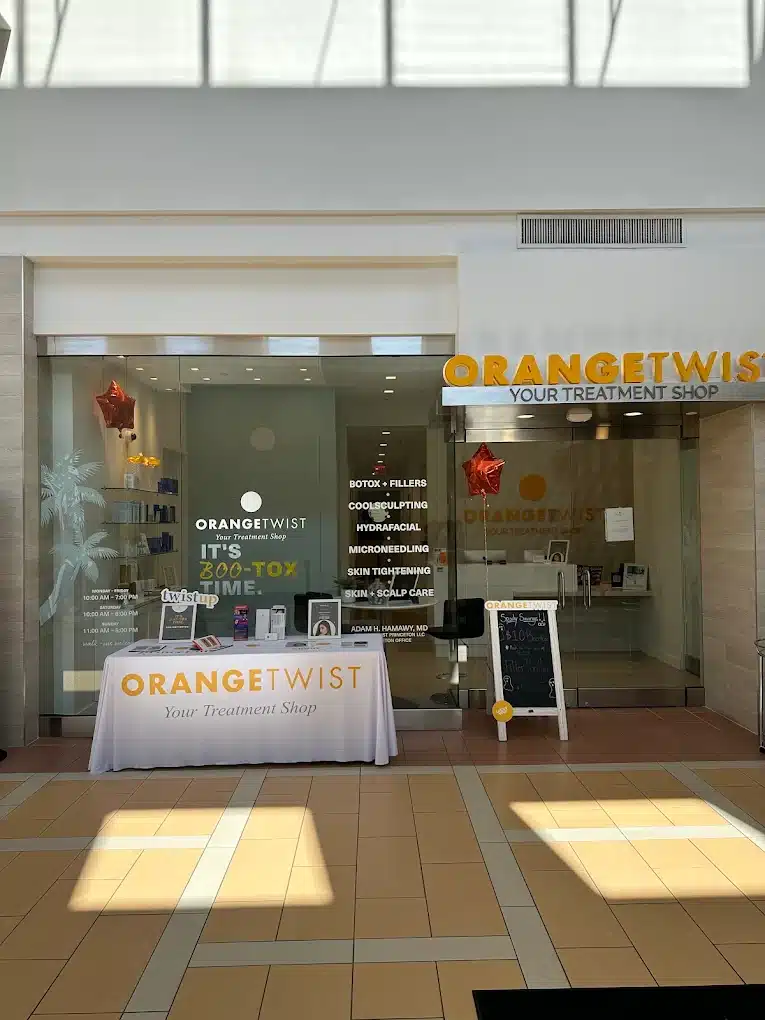
OrangeTwist Princeton is at 3535 US-1 South, Suite 463A, Princeton, NJ 08540, in MarketFair on US-1 South. Free parking is available in the mall lot. Call (609) 445-1200 or email Princeton@OrangeTwist.com and the team will help from there.
The bottom line
Tear trough filler is one of the most transformative treatments for the right candidate, and one of the most problematic for the wrong one. The single most important step is a thorough assessment by a provider experienced in the periorbital area. A complimentary You Review at OrangeTwist Princeton is where that conversation starts and where you get an honest answer about whether filler is right for your specific concern.
Ready when you are
Book a complimentary You Review and we will assess your under-eye area honestly, determine whether filler is the right tool for your concern, and map a realistic plan.
Visit us in Princeton

Monday
Tuesday
Wednesday
Thursday
Friday
Saturday
Sunday
9:00 AM – 6:00 PM
9:00 AM – 6:00 PM
9:00 AM – 6:00 PM
9:00 AM – 6:00 PM
9:00 AM – 6:00 PM
9:00 AM – 5:00 PM
10:00 AM – 5:00 PM

Jalyssa Rodriguez
Center Manager



Got Goals?
We’re Listening.
Book your no-pressure, no-cost You Review and let’s talk about your vision.